Ocala, FL · Garage Door Service
Garage door repair for Fort King District, four miles east of Ocala, where 1980s builder-grade doors and torsion hardware from that era are still common on these streets.
Fort King District sits about four miles east of downtown Ocala, closer to the center of town than most of the other neighborhoods we work in. It's a short run for us, which matters when a spring lets go on a Tuesday morning and the car is trapped inside. We also cover Silver Springs, six miles out, and Silver Springs Shores a bit farther at nine, but Fort King District is the closest stop on our board and usually the first call we can get to on a tight morning.
This isn't a neighborhood defined by one big landmark or a single builder's name we can point to - it's a pocket of houses close enough to Ocala's center that most of what we see here matches the wider building pattern across this side of the county rather than one distinct development. That consistency actually helps when we're pricing a job over the phone: the housing stock tells us most of what we need to know before the truck rolls.
Most of the houses on this side of town went up between 1982 and 1994, with the median build year landing around 1983. That's a specific stretch of construction, and it shows up in the doors: a lot of original steel sectional doors on extension-spring hardware, the kind builders installed by the pallet-load through the 80s and into the early 90s. Torsion conversions exist here too, but they're the exception, not the rule, on a house this age unless a prior owner already replaced the door once.
Ocala sits in a mild temperate band, so we don't deal with the freeze-thaw cracking or ice-jammed track you'd get farther north. What we do see is UV and humidity working on thirty-to-forty-year-old panels and seals - foam-core insulation losing its bond to the steel skin, bottom seals gone brittle, and the occasional galvanized track that's pitted more than bent. None of that is dramatic. It's just steady wear on doors that were never built to last past the warranty period they came with.
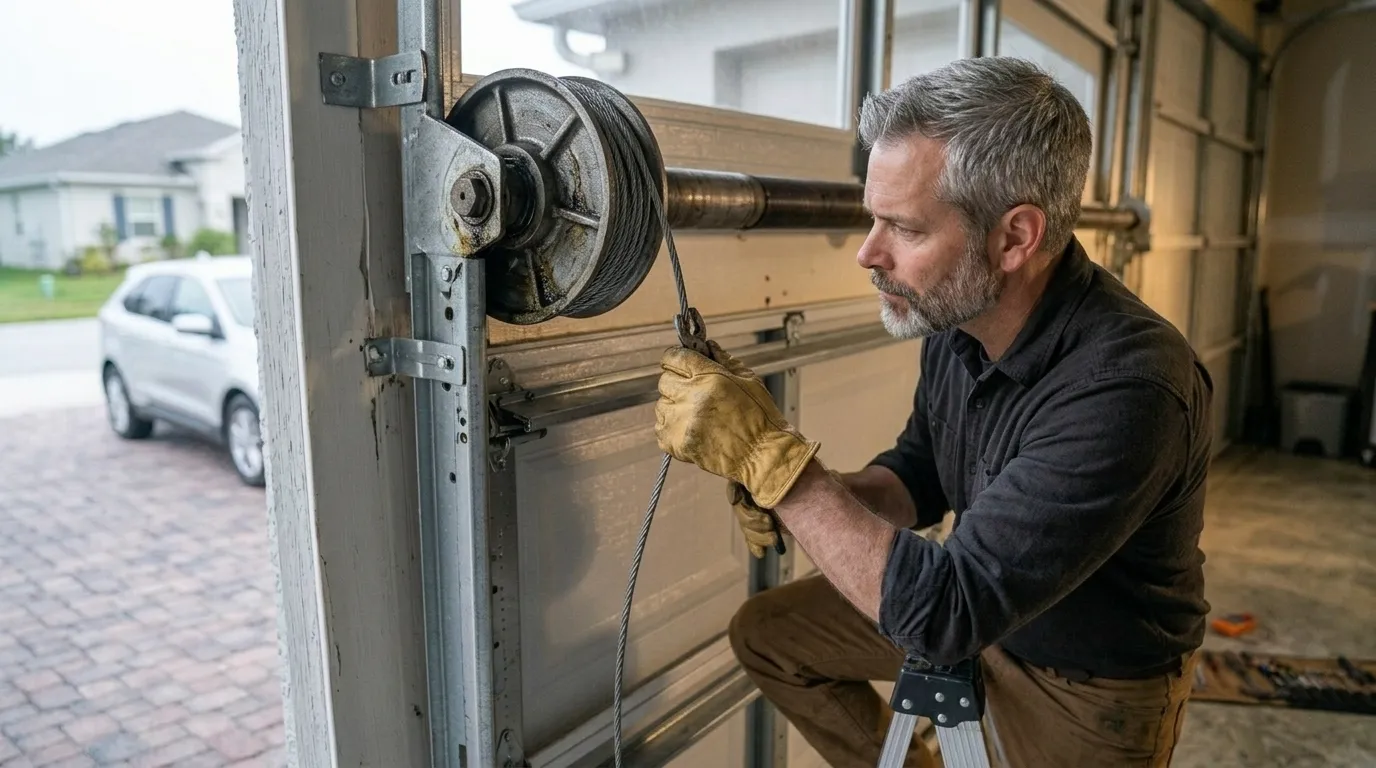
Given the age of the stock, the calls out here run predictable. Extension springs snapping on original hardware is the single most common job - those springs weren't rated for the decades of cycles they've now put in. Opener boards from the 80s and 90s installs failing outright is the second, since most of those units are well past any reasonable service life and parts for the oldest models simply aren't made anymore.
We also get a fair number of bottom seal and weatherstrip replacements, cheap parts that do a lot of work once a door's been sitting in Florida humidity for thirty-plus years. One honest limitation: if a door's steel has actually rusted through at the bottom panel, we're not going to patch it - that's a replacement conversation, not a repair one, and we'll tell you that on-site instead of billing you for a fix that won't hold. With a median household income of $44,479 across the service area, most owners here go with the repair or spring swap over a full replacement when the door itself is still sound, and on houses this age, it usually is.
It's about four miles east of downtown Ocala, one of the closer neighborhoods we run to. That short distance usually means we can get someone out the same morning for a stuck or broken door, weather and schedule permitting.
If the panels and track are sound, a spring or opener repair usually makes sense - most of the failures we see on houses from this era are hardware, not the door itself. If the steel's rusted through at the bottom, we'll tell you straight that replacement is the better call.
Often, yes. A lot of the openers installed during the original 1980s-90s build wave are past parts availability, so when the board or motor fails, swapping the unit is usually cheaper and more reliable than chasing obsolete parts.
Call now or request a free quote - same-day service on most repairs, upfront written pricing.