Ocala, FL · Garage Door Service
Most Ocala homes date to 1982-1994 with original doors past their service life. See what a straight install job looks like and why timing matters here.
If you're searching for a new garage door in Ocala, chances are the one you have now is original to the house. F1 puts most of the local housing stock at 1982 to 1994, median build year 1983, and F2 confirms that pattern holds across five named areas of town. A steel door from that era has usually gone through 30-plus summers of Florida humidity and UV without ever being swapped. You'll see the tells: the panels have a chalky, faded look even after washing, the bottom section is soft or rusted through at the corners, and the door sags visibly when it's up on the track. Sometimes the opener still runs fine - it's the door itself that's worn out, not the motor. Other times a homeowner calls about a spring that keeps snapping every year or two, and the real issue is that the door is heavier than it should be because the old torsion hardware was never sized for a replacement door's spring. Either way, once a door hits this age in this climate, patch repairs start costing close to what a new install would run, and they don't last as long.
Some of this you can check yourself before you call anyone. Pull the release cord, lift the door by hand, and see how it moves - if it's heavy, uneven, or drops on its own, the door and springs are mismatched or worn out, and that's not a DIY fix. Measuring your rough opening and comparing it against a new door's spec sheet is something any homeowner can do, and it's worth doing before you get a quote so you know what you're working with. What you shouldn't do yourself is remove an old door with wound torsion springs still on the shaft, or set a new door's track and springs without the right bars and clamps - that's the part of this job that puts people in the ER, not the part that saves them money. If your opener is newer than the door, we can usually reuse it; if it's original too, that's worth mentioning when you call so it gets priced in from the start.
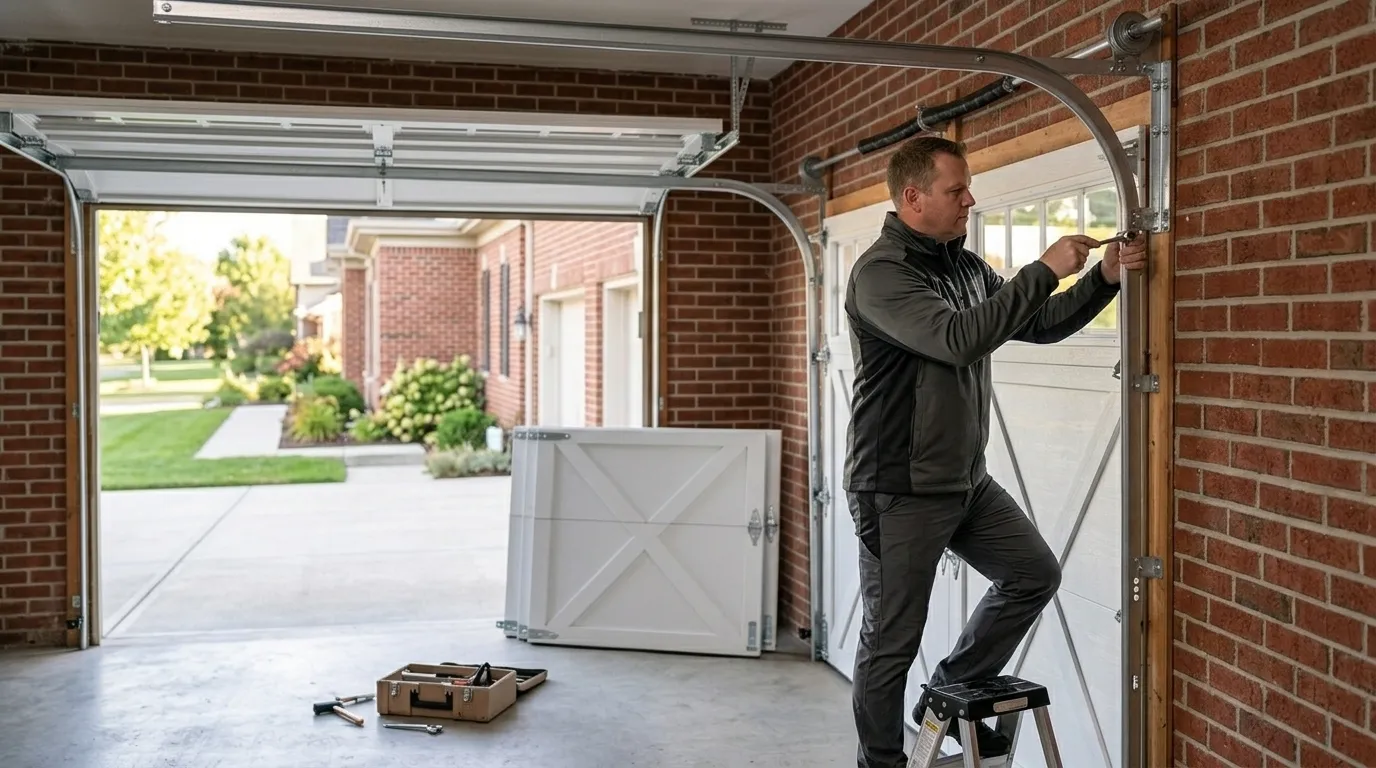
A straight install - old door out, new door and matching torsion springs in, opener reconnected and balanced - is a one-day job in most cases. Where it runs longer is when the opening itself has shifted or the old jamb wood has softened, which shows up more often on houses at the older end of that 1982 build range. We size the new springs to the actual door weight rather than reusing what was on the wall, since that mismatch is the single biggest reason doors fail early here. We also check the track alignment against the slab - Florida slabs move a little over three decades, and a door that's dead level on paper can still bind if the track wasn't reset to match. One honest limit: if the opening itself is out of square by more than a small amount, that's a carpentry fix outside a straight door swap, and we'll tell you that up front rather than force a door into a bad frame.
Two things push installation calls here more than anywhere else: age and climate. F1 and F2 mean a large share of Ocala's houses are all hitting the same 30-to-40-year mark on their original doors at roughly the same time, which is why this is such a common call across the service area rather than an occasional one. F3 puts Ocala in a mild temperate band, so we're not dealing with hard freeze-thaw cycles that crack panels the way colder regions see - but the flip side is steady humidity and UV exposure that slowly breaks down old paint seals and lets moisture into the steel and wood trim over years, which is a different, slower kind of failure than what you'd see up north. With F6 showing over 9,300 owner-occupied houses across a service area with a median household income around $44,479, replacement decisions here tend to be practical ones - people want a door that will run another 25 years without drama, not the most expensive option on the shelf. That's the door we spec for most calls we get in this area.
If the panels are rusted through, the door won't sit flush when closed, or springs keep failing on a door that's original to a house built in the 1980s or early 90s, replacement usually makes more sense than another patch repair. We'll look at the actual door on the call and tell you honestly which side of that line you're on.
Often, yes, if the opener itself is newer than the door and still working well. We check the mounting and force settings during the install rather than assume - a heavier or lighter new door changes how the opener has to work, so it gets rebalanced either way.
Ocala sits in a mild temperate band, so freeze damage isn't the concern it is farther north. The bigger factor here is long-term humidity and UV exposure, which is why we steer people toward finishes and seals built to hold up over years outdoors rather than the cheapest steel option.
Call now or request a free quote - same-day service on most repairs, upfront written pricing.